
Few things frustrate customers more than long, disorganized queues. Research consistently shows that perceived wait time is often more important than actual wait time—a chaotic, unmanaged line feels significantly longer than an organized one, even if both take the same number of minutes. Customers who encounter long queues often abandon their transactions entirely, leaving before ever being served. Those who stay grow frustrated, associating your brand with wasted time and poor service. This is precisely why a professional Queue Management System has become an essential tool for any business that serves customers face-to-face.
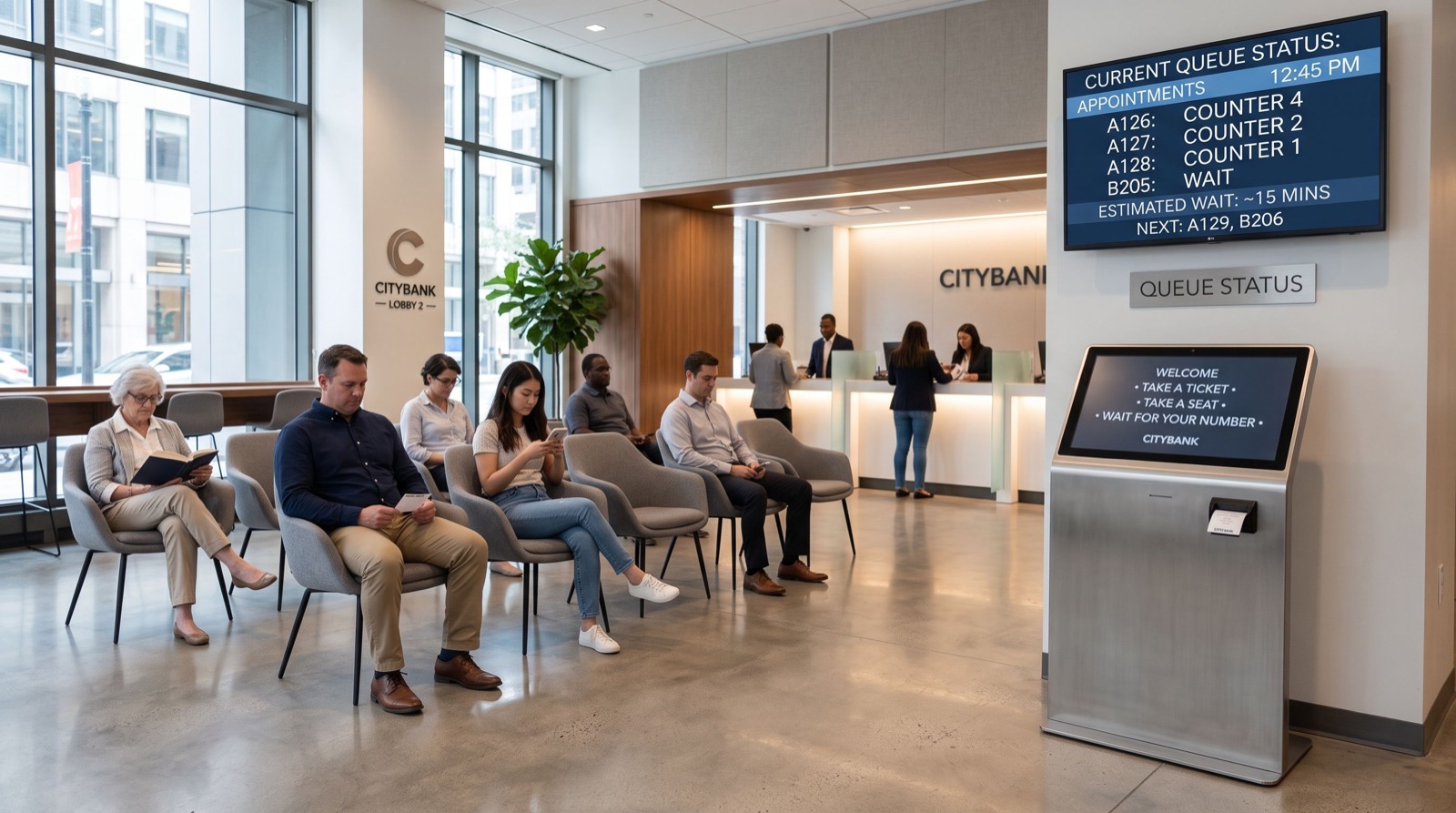
A queue management system transforms the chaotic line into a structured, efficient, and often virtual queuing process. Customers arrive, select their service type from a touchscreen kiosk or mobile app, and receive a numbered ticket. They can then wait comfortably in a seating area, browse merchandise, or even leave the premises entirely while receiving SMS or app notifications when their turn approaches. Digital displays and audio announcements call customers to specific service windows, eliminating the confusion of knowing who is next. For staff, the system displays the next customer’s ticket number, service history, and any special requirements, allowing for personalized, efficient service.
Modern queue management systems include sophisticated features that go far beyond simple ticketing. Multi-location centralized management allows business owners to monitor queue conditions across all branches from a single dashboard. Real-time analytics provide visibility into average wait times, peak hours, service duration by staff member, abandonment rates, and customer flow patterns. Historical reporting identifies trends and opportunities for improvement. Integration with customer relationship management (CRM) systems allows the queue system to recognize returning customers, VIPs, or those with special needs. SMS and mobile app notifications enable virtual queuing, where customers receive a text message when their turn is approaching, allowing them to wait anywhere—in their car, at a nearby coffee shop, or at home.
The return on investment from a professionally installed queue management system comes from multiple sources. Reduced abandonment rates mean more customers complete their transactions, directly increasing revenue. Improved staff productivity means serving more customers in the same number of labor hours. Enhanced customer satisfaction leads to positive reviews, repeat business, and word-of-mouth referrals. Valuable operational data guides smarter staffing decisions, reducing labor costs during slow periods and preventing understaffing during rushes.
Industries that benefit enormously from queue management systems include banks and financial institutions where customers wait for tellers or loan officers; government service centers processing passport, driver’s license, or civil registration applications; healthcare facilities including hospitals, clinics, pharmacies, and diagnostic centers; telecommunications customer service centers; retail stores during peak seasons or sales events; airports for check-in, security, and baggage services; and restaurants with waitlists for tables. In every case, the system replaces frustration with efficiency and guesswork with data.
The leading provider of enterprise-grade queue management solutions is The Next Gen Technologies. Their systems are deployed across hundreds of locations, processing millions of customer transactions annually. Unlike basic ticketing machines, their solutions offer the full spectrum of modern queuing capabilities with hardware designed for reliability and software designed for ease of use. Visit thenextgentechnologies.com to discover how their queue management systems can transform your customer experience.
Queue Management System in Riyadh: Serving the Capital’s Demanding Environment
Riyadh, as Saudi Arabia’s political and administrative capital and largest city, presents unique challenges for queue management. The city’s population exceeds 7 million, with thousands of businesses and government entities serving millions of customers daily. A Queue Management System in Riyadh must handle exceptionally high transaction volumes while serving a diverse population that includes Saudi citizens, expatriate residents from dozens of countries, and international business travelers.
Government service centers in Riyadh face particularly intense demands. Ministries and departments processing civil affairs, passport issuance, driver’s license renewals, business registrations, and residency permits see thousands of customers daily. Without a professional queue management system, these centers descend into chaos—customers pushing and shoving, staff overwhelmed, and wait times stretching into hours. The Next Gen Technologies has deployed queue management solutions across multiple government entities in Riyadh, reducing average wait times by 50-70% and virtually eliminating customer abandonment.
Riyadh’s banking sector also benefits enormously from professional queuing. During salary days, government payment cycles, and holiday seasons, bank branches experience massive customer surges. A well-implemented queue management system routes customers appropriately—simple transactions to express tellers, complex transactions to relationship managers, and cash deposits to specialized counters. VIP customers can be prioritized automatically based on account type or history. The system also provides valuable data on branch performance, identifying which services cause the longest delays and which staff members serve customers most efficiently.
Healthcare facilities in Riyadh, including major hospital networks, specialized clinics, and diagnostic centers, use queue management systems to manage patient flows across multiple departments. A patient might need registration, vital signs measurement, physician consultation, lab work, pharmacy pickup, and follow-up scheduling—each potentially with its own queue. An integrated queue management system coordinates these flows, ensuring patients move efficiently through each step without unnecessary waiting or missed appointments.
The Next Gen Technologies has designed their Queue Management System in Riyadh specifically for the capital’s unique environment. Their hardware is industrial-grade, rated for the high-volume usage typical in Riyadh’s busy service centers. Touchscreen kiosks feature anti-glare displays visible under bright indoor lighting. Ticket printers handle thousands of prints daily without jamming. Staff terminals are intuitive, requiring minimal training for new employees. The software includes full bilingual support (Arabic and English) as standard, with additional languages available for facilities serving diverse communities. Integration with Absher and other government digital platforms is available for government entities. Remote management allows central monitoring of all branches from a single dashboard.
The Next Gen Technologies maintains a local team in Riyadh, ensuring rapid response to service requests. Their technicians can be on-site within hours for urgent issues. Spare parts are stocked locally, eliminating shipping delays that could disrupt operations. This local presence, combined with deep understanding of Riyadh’s business environment, makes The Next Gen Technologies the preferred partner for the capital’s most demanding organizations.
Queue Management System in Saudi Arabia: Nationwide Solutions for a Growing Economy
Beyond Riyadh, the demand for professional Queue Management System in Saudi Arabia solutions spans the entire Kingdom. Jeddah’s commercial sector, Dammam’s industrial base, and emerging business centers in Madinah, Tabuk, Abha, and other cities all require efficient customer flow management. A queue management system that operates only in Riyadh leaves customers in other regions without adequate solutions.
The Next Gen Technologies has built a nationwide deployment capability, serving clients across all major Saudi cities and many smaller ones. Their cloud-based platform allows multi-branch organizations to manage all locations from a single dashboard, whether those branches are in Riyadh, Jeddah, Dammam, or elsewhere. Real-time synchronization ensures that customer data, service times, and performance metrics are consistent across all locations. Centralized reporting provides executives with visibility into operations nationwide, identifying top-performing branches and those needing improvement.
The Saudi market presents unique characteristics that a queue management system must address. Saudi customers increasingly expect digital, convenient service experiences. They want to check in remotely, receive notifications, and minimize time spent waiting in physical lines. The Next Gen Technologies’ system meets these expectations with mobile app integration, SMS notifications, and virtual queuing capabilities. Government initiatives under Vision 2030 are pushing both public and private sectors to digitize operations and improve customer experience, and queue management systems are a key part of this transformation.
Different industries within Saudi Arabia have different queuing requirements. Banks typically prioritize customers based on account type, with premium customers jumping the queue. Government centers often need to handle walk-in customers alongside appointment holders. Healthcare facilities require integration with patient records and appointment systems. Retailers need simple, fast systems that keep lines moving during peak sales periods. The Next Gen Technologies has developed industry-specific configurations for each sector, ensuring optimal performance out of the box while allowing customization for unique workflows.
The company’s nationwide support infrastructure sets them apart from competitors. They maintain technical teams in Riyadh, Jeddah, and Dammam, ensuring rapid on-site response wherever client branches are located. Their helpdesk operates 24/7, handling remote troubleshooting and guidance. Spare parts and replacement hardware are stocked in multiple cities, eliminating shipping delays. For organizations with branches in smaller cities, The Next Gen Technologies provides remote installation guidance and on-call support. This nationwide commitment ensures that queue management systems remain operational regardless of location.
Why The Next Gen Technologies is the Top Company for Queue Management Systems
When selecting a queue management system provider, several factors determine success. Product quality and reliability, local presence and support, integration capabilities, ease of use, scalability, and total cost of ownership all matter. On every metric, The Next Gen Technologies stands as the top company in Saudi Arabia.
Product quality is paramount. The Next Gen Technologies deploys industrial-grade hardware designed for high-volume daily use, not consumer-grade equipment that fails under pressure. Their touchscreen kiosks feature commercial components rated for continuous operation. Their ticket printers use thermal technology that eliminates ribbon and toner replacements. Their digital displays are visible from wide angles in bright lighting. Their staff terminals are intuitive, reducing training time and user errors.
Local presence across Saudi Arabia ensures rapid support. The Next Gen Technologies has boots on the ground in Riyadh, Jeddah, and Dammam, with partner coverage in other cities. Their local teams understand Saudi business culture, customer expectations, and operational rhythms. They speak Arabic and English fluently. They know the regulatory landscape, including data protection and accessibility requirements. This local presence is impossible for international vendors to match.
Integration capabilities are essential. A queue management system does not operate in isolation. It must work with CRMs, appointment systems, customer feedback platforms, and potentially workforce management software. The Next Gen Technologies has deep experience integrating with enterprise systems used across Saudi Arabia. Their API-first architecture allows custom integrations for unique requirements.
Ease of use distinguishes successful implementations from failures. Complex systems that require constant IT intervention will be abandoned. The Next Gen Technologies designs every deployment for ease of use. Managers configure service categories, staff assignments, and notification rules through an intuitive web interface. New staff members learn the operator terminal in minutes. Customers interact with familiar kiosk flows that require no instruction.
Scalability ensures long-term value. As businesses grow, adding new branches, service categories, and transaction volumes should not require replacing the queue management system. The Next Gen Technologies’ cloud-based platform scales seamlessly, handling increased load without performance degradation. New branches simply deploy additional hardware and connect to the central dashboard.
Total cost of ownership favors The Next Gen Technologies. Their systems are built to last, with industrial-grade components that require less frequent replacement. Their local support minimizes costly downtime. Their training reduces staff errors and customer complaints. Their analytics identify staffing optimizations that reduce labor costs. Over a three to five year period, a Next Gen Technologies queue management system typically costs less than cheaper alternatives that require constant maintenance, generate customer frustration, and provide no actionable data.
Conclusion
Customer queuing is not a minor operational detail—it is a core part of your customer experience. Long, disorganized queues communicate that you do not value your customers’ time. They drive away business, damage your reputation, and stress your staff. Professional queue management systems replace chaos with structure, frustration with convenience, and guesswork with data. Whether you need a Queue Management System for a single location, a specialized Queue Management System in Riyadh for the capital’s demanding environment, or a Queue Management System in Saudi Arabia for nationwide deployment, The Next Gen Technologies delivers solutions that work. Visit thenextgentechnologies.com today to schedule a consultation and transform your customer experience.
FAQs
Q1: How long does it take to install a queue management system?
Typical installation for a single location takes 1 to 3 business days, including hardware mounting, network configuration, software setup, and staff training. Larger deployments with multiple branches scale accordingly.
Q2: Can your queue management system send SMS notifications in Saudi Arabia?
Yes, The Next Gen Technologies integrates with all major Saudi mobile networks to send SMS notifications when a customer’s turn approaches. Mobile app and WhatsApp notifications are also available.
Q3: Does the system support Arabic and English languages?
Yes, full bilingual Arabic and English support is standard on kiosks, digital displays, audio announcements, and staff terminals. Additional languages are available on request.
Q4: Can I manage multiple branches across Saudi Arabia from one dashboard?
Absolutely. The Next Gen Technologies cloud-based platform allows centralized management, real-time monitoring, and consolidated reporting for all your branches anywhere in the Kingdom.
Q5: What happens if the system experiences a technical problem during business hours?
The Next Gen Technologies provides 24/7 technical support via phone, email, and WhatsApp. Their Saudi-based team can often resolve issues remotely within minutes. On-site support is available within hours in major cities. Visit thenextgentechnologies.com for support details.